Most real estate websites have a contact form. Name, email, phone number, maybe a dropdown for "interested in." The sales team gets the submission, but they have no idea what the buyer was actually looking at.
Contextual leads are different.
What is a contextual lead?
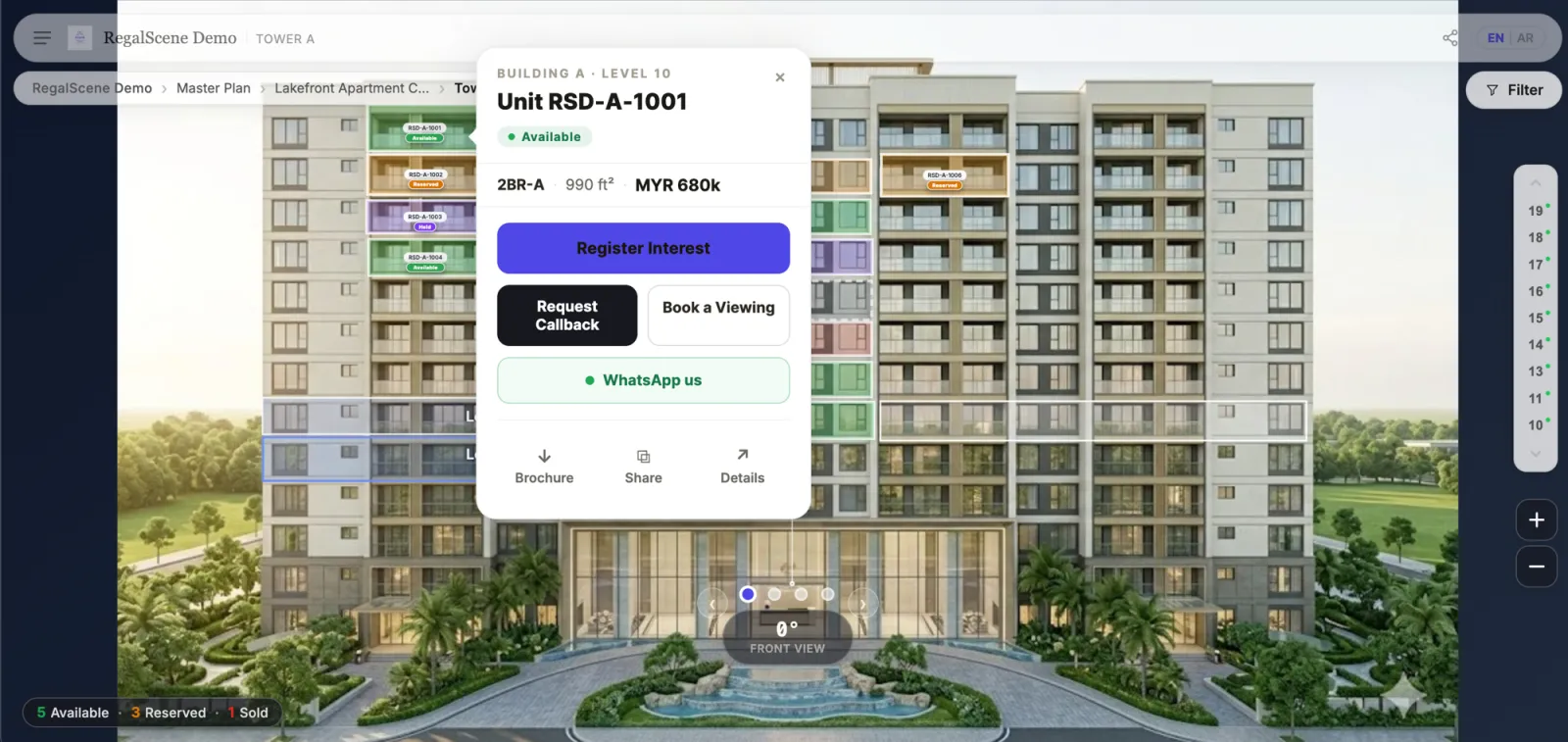
A contextual lead includes not just the buyer's contact details, but the full exploration path that led to the enquiry:
- Which project they were viewing
- Which building or precinct they selected
- Which floor they explored
- Which unit they opened
- Which CTA they clicked (enquiry, callback, brochure download)
- What device they were on
- When they submitted
This context transforms a generic "someone is interested" into "this buyer spent five minutes comparing three-bedroom units on levels 10-15 of Residence B, then requested a callback on Unit 1204."
Why context matters for sales
Faster, more relevant follow-up
When a sales agent calls a lead, they can start the conversation with: "I see you were looking at the three-bedroom units in Residence B — would you like to know more about the view from level 12?" That's a different conversation than "How can I help you?"
Better lead qualification
Context signals intent. A buyer who explored five different unit types across three buildings is in a different stage than someone who clicked one link. The sales team can prioritize accordingly.
Smarter marketing decisions
Aggregate lead context reveals demand patterns. If most enquiries come from waterfront-facing units on mid-high floors, that's a signal for pricing, inventory release, and campaign targeting.
How contextual leads work
In a digital sales center, the buyer's exploration is tracked as they navigate through scenes. When they submit an enquiry, request a callback, or register interest, the system attaches their exploration context to the lead automatically.
The buyer doesn't need to fill in extra fields. The context is captured from their journey — which scenes they visited, what they clicked, how long they explored.
That capture is how contextual leads reach the sales team with the path already on them, rather than as a name someone has to research before dialing.
Context only works if the sales team sees it in time
The failure mode with contextual leads is almost never capture. It is delivery. A lead can arrive carrying the full exploration path and still get answered like a cold form submission, because that path is sitting in a CRM custom field nobody opens on a Tuesday afternoon.
Three decisions fix it, and all three are made before launch, not after the first slow week.
Decide where the context lands. Not "in the system." In the notification a consultant reads on their phone, in the first line of the CRM note, in the message that opens the WhatsApp handoff. The test is blunt: hand a consultant a real lead on a phone and have them read the first sentence aloud. If that sentence does not name a unit, the context is not being delivered.
Agree what "warm" means before the leads arrive. If every enquiry looks identical in the queue, every enquiry gets the same call. Depth of exploration, a return visit, an enquiry sent from a specific unit rather than a general form: any of these can sort the queue. None of them will, unless someone writes the priority rule first.
Treat context as perishable. Priority should read the exploration timestamp, not the submission timestamp alone. A buyer who compared three layouts on Sunday night is a different prospect on Monday than on Friday.
Context that arrives after the first call is a report. Context that arrives with the notification is a script.
The result
Sales teams open the call already knowing what the buyer was looking at. Buyers get a faster answer to the question they were actually asking. Marketing reads the same enquiries as demand data: which units, which floors, which orientations. A static form captures none of that, because a form only records the last thing the buyer did.
Related reading:
- Real Estate Buyer Intelligence: A Guide for Developers
- How Interactive Property Experiences Increase Sales Conversion
- Digital Lead Generation for Real Estate: Beyond the Contact Form
- What Is a Digital Sales Center for Real Estate?
- Selling Property to Chinese Buyers Digitally
Lead Engine captures buyer intent with full exploration context. See how it works or book a demo.